
Subtle Contradictions, Key to Power Dressing
Contradiction is no longer optional when dressing with authority at work.
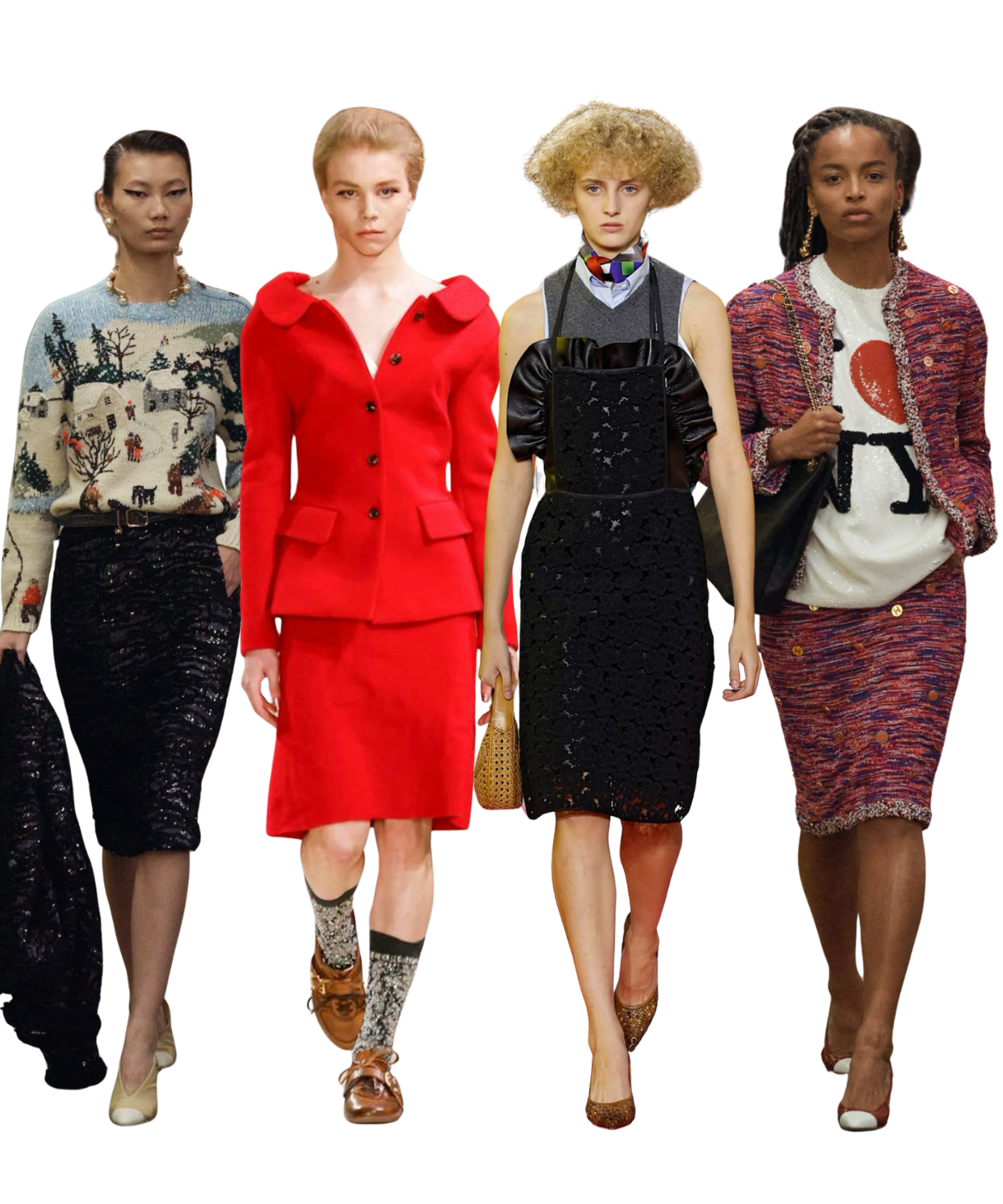
Above (from left/Top): Chanel PF2026, Miu Miu FW2025, Miu Miu PF2026, Chanel PF2026.Style today isn’t primarily about polish. It’s about tension. Unexpected pairings. Outfits that read as current rarely look perfectly resolved or overly literal. They look deliberate — but not obedient. Coherent, but not formulaic. In other words, they contain contradiction: a controlled friction that signals judgment, not compliance.
Contradiction has long been at the core of style…
Fashion has always generated meaning through opposition — contrast is part of the system. But the nature, meaning, and execution of that contradiction are not fixed. They evolve.
Some contrasts are now fully baked into fashion’s vocabulary: black and white, masculine and feminine, tailored and relaxed. They remain essential, but they’re also widely understood, expected, almost automatic. Today, style moves beyond clear binaries toward something more intricate and less resolved.
That’s because style is no longer about demonstrating that you know the rules — and can apply them dutifully — but about demonstrating savvy and judgment. Harmony shows fluency. Contradiction reveals discernment in ambiguity. It’s only when opposing signals coexist — without cancelling each other out — that style reads as empowered rather than subservient.
… But playing with contradiction has become more complex, reflecting shifting socio-economical attitudes
There are societal reasons why contradictions have become more complex, more layered, and harder to settle. As society has evolved, so has style. Signals of status, authority, and taste are no longer stable and uncontested. Where contrast (and power) once relied on clear hierarchies, style (and power) today operates through tensions that remain intentionally open. Status symbols are no longer displayed at face value; they’re played with, displaced, softened, sometimes even undermined.
Over roughly the last decade and a half, three shifts made contradiction not only acceptable, but necessary.
First, power itself has been reshuffled. Authority no longer has a single visual language. Where the suit once stood as the dominant symbol of success, power today is embodied just as visibly by tech founders in hoodies, cultural figures, artists, and digital entrepreneurs. Streetwear didn’t invent contradiction, but it gave this redistribution of power a visual grammar. The casual entered the formal, the everyday entered luxury, and attitude began to outweigh refinement.
Second, strict category boundaries collapsed. The old separations — workwear versus weekend, formal versus casual, day versus night — weakened. Hybrids became normal. Clothing stopped belonging to one clearly defined context and started circulating across many. As a result, contradiction stopped being a special effect and became an everyday grammar. Getting dressed now routinely involves holding multiple registers at once.
Third, visibility intensified. In an image-saturated culture, looking simply “correct” lost much of its impact. Visual sameness reads as anonymity. Distinction now requires nuance. Contradiction offers a way to signal discernment and leadership without overt display.
The result is that style has become less about looking “right” and more about looking considered, intentional, and in control — as if the wearer is actively making choices, not following a predefined, dated template.
So what does this mean for dressing with authority at work?
Corporate environments still reward legibility. Even as formal dress codes loosen, the underlying expectation remains: don’t distract, don’t confuse. Seriousness is still expected to be immediately recognizable.
The problem is that strict conformity now carries its own risk. Lean too hard into the standard uniform and you start to read as passive — competent, but lacking judgment. A perfectly polished look can still communicate capability, but it can also suggest compliance and lack of critical thinking. On the other hand, leaning too far into style risks looking overly focused on appearance, as though aesthetics were competing with substance.
This is where controlled contradiction becomes meaningful. Style, when calibrated, communicates more than correctness. It communicates judgment. It signals that you understand the codes well enough to bend them — without losing authority, let alone credibility. That’s why contradiction often reads as confidence. It implies the wearer isn’t dressing by default. She isn’t a follower. She’s informed and deliberate.
Of course, the margin for error at work is narrow. The tolerance for ambiguity is lower, and the penalties for miscalibration are higher.
Done badly, contradiction reads as misplaced and accidental. The difference between stylish tension and a hot mess isn’t bravery — it’s precision.
But seen from the flip side, precisely because the workplace is conservative, small contradictions carry disproportionate power. In a sea of sameness, a subtle tension can make an outfit feel current and intentional — without being loud.
This is where ability to play with micro-contradictions for power dressing becomes a professional asset. It allows to look authoritative without looking cookie-cutter; stylish without looking unserious; modern without looking like you’ve mistaken the quarterly earnings call with a catwalk. It adds dimension without asking for attention.
How contradiction for style shows up at work
At work, the contradictions that succeed are usually structural rather than performative:
texture against texture
(tweed with something unexpectedly light-catching or refined)a severe silhouette with a softened element
(sharp tailoring paired with fluidity rather than volume)an institutional piece offset by a detail that introduces tension
(heritage or uniform-coded elements subtly destabilized)precision paired with ease
(impeccable cut worn without stiffness)restraint interrupted by one deliberate signal
(nothing cumulative, nothing explanatory)
